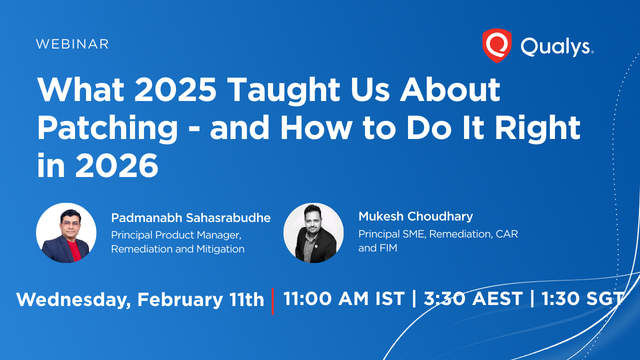
2025 didn’t just increase vulnerability volume; it exposed a broken patching model.
With 1,130+ CVEs, escalating zero-day attacks, and elevation-of-privilege vulnerabilities dominating breach paths, security and IT teams learned the hard way that patch-first doesn’t always mean risk-reduced.
In this session, experts from Qualys break down what failed in 2025, and why 2026 demands a risk-driven, remediation-first approach.
You’ll see how TruRisk Eliminate helps organizations handle what traditional patching can’t:
- Zero-day vulnerabilities
- End-of-life software
- Business-critical systems that can’t tolerate downtime
- Configuration-based and non-patchable vulnerabilities
We’ll contrast the old, panic-driven patching model with a modern approach built on precision, automation, and engineered resilience, so you’re not repeating the same outages this year.
What You’ll Learn:-
1. Why non-patchable vulnerabilities are becoming the biggest blind spot, and how to address them with permanent fix strategies
2. How to handle critical vulnerabilities that can’t be patched immediately using mitigation-first approaches
3. How to reduce patch failures with risk-aware testing and patch reliability strategies
4. The mindset shift from:
- Security-driven panic → Risk-driven precision
- One-time mass deployments → Content & ring-based rollouts
- Hero-based recovery → Automated, engineered resilience
5. What a 2026-ready patching and remediation model actually looks like in production.