InfoTechTarget and Informa Tech's Digital Businesses Combine.

Together, we power an unparalleled network of 220+ online properties covering 10,000+ granular topics, serving an audience of 50+ million professionals with original, objective content from trusted sources. We help you gain critical insights and make more informed decisions across your business priorities.

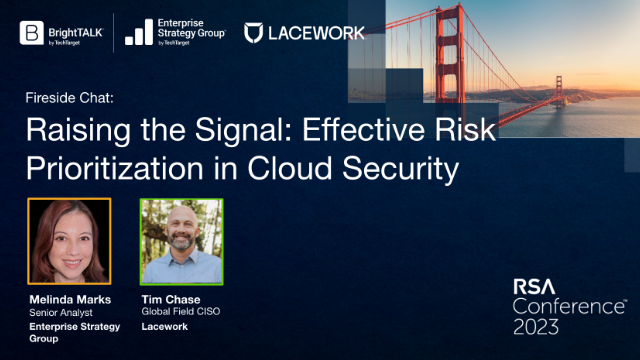
Raising the Signal: Effective Risk Prioritization in Cloud Security

Presented by

Melinda Marks, Senior Analyst, Enterprise Strategy Group and Tim Chase, Global Field CISO, Lacework

About this talk

Because cloud environments are noisy, nobody has enough resources to pay attention to every single alert. The only way to effectively prioritize risks and detect threats, therefore, is to gain complete visibility and context from code to cloud. To achieve this feat requires consolidating all previously siloed capabilities—e.g. scanning of cloud accounts for misconfigurations, CSPM, CIEM, KSPM, CWPP, and more—to a single view. Given these myriad components, the path to success is often, well, cloudy. In this Fireside Chat, ESG Senior Analyst Melinda Marks sits down with Tim Chase, Global Field CISO at Lacework, to examine actionable strategies with which you can cut through the noise to prioritize cloud security risks with precision. Tune in to discover how: • To strengthen cloud security risk prioritization • Developers and security pros should collaborate to identify vulnerabilities • Lacework helps their customers reduce cloud attack surfaces • And much more
Lacework

Lacework

2217 subscribers46 talks
Security For The Cloud Generation | Build Fast, Run Fearlessly
Lacework is the security company for the cloud. The Lacework Cloud Security Platform is offered as-a-Service and delivers build-time to run-time threat detection, behavioral anomaly detection, and cloud compliance across AWS, GCP, Azure, and Kubernetes services, workloads, and containers. Trusted by enterprise customers worldwide, Lacework significantly drives down costs and risk, and removes the burden of unnecessary toil, rule writing, and inaccurate alerts.
Related topics