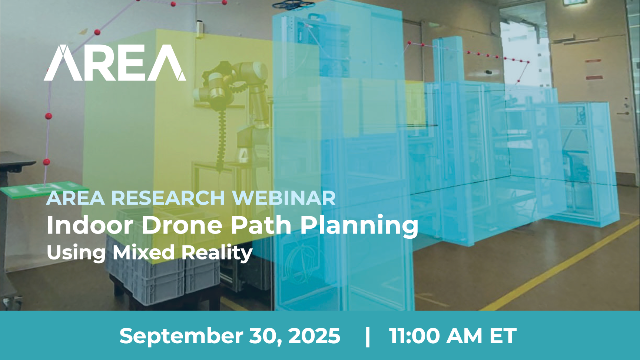
Robots are increasingly tasked with navigating environments and manipulating objects, requiring careful movement planning to avoid collisions and ensure safety—especially when humans share the space. To reduce ground congestion and incidents, flying drones can complement ground robots, but their indoor movements also demand precise planning.
Key considerations for drone path planning include safety, privacy, and minimizing disturbances such as noise or airflow. Defining virtual avoidance or permission zones for user-controlled drones is a valuable feature that can be integrated into their path planning. AR and VR displays have long enhanced drone operations by visualizing camera feeds and flight paths, especially when drones are out of direct sight.
Researchers at the University of Southern Denmark have explored XR (extended reality) for drone path planning. An ISMAR2024 paper presents user testing results comparing handheld AR and head-worn XR headsets for planning drone tasks. The study involved developing XR applications in Unity, allowing users to perform planning tasks similar to those on desktop computers but within immersive XR interfaces.
This webinar, led by the research team, will introduce technologies for indoor robot and drone path planning using XR and present their findings. Topics include: how XR path planning considers both physical and virtual objects; the development and evaluation of the AR/XR applications; how interaction with virtual objects can improve or complicate drone path planning; and future research directions.
Attendees will gain insights into automated and manual indoor path planning for robots using AR/XR, and results from user studies comparing handheld AR and head-worn XR devices.